Global virtual events: engaging audiences across borders

Global virtual events remove the logistical constraints that limit who can attend, when they can attend, and how deeply they can engage. But removing the geographical barrier is the easy part. The harder problem is building an event experience that generates genuine participation from an audience spread across time zones, languages, and cultural contexts. This guide covers the formats, mechanics, and measurement approaches that make global virtual events work for event agencies and brand teams running international activations.
Key Highlights
- Global virtual events succeed when they combine synchronous formats for peak participation moments with asynchronous formats that sustain engagement across time zones before and after the live session.
- The most common failure mode in international virtual events is designing for a single time zone and calling it global. An event that runs at 3pm GMT works well for Europe and poorly for everyone else.
- Async engagement formats like predictor games, daily puzzle challenges, and leaderboard-based competitions generate meaningful participation from geographically distributed audiences without requiring simultaneous attendance.
- Virtual event engagement metrics for global events should include participation by region, async-to-sync participation ratio, and return engagement rate across the full event window, not just live session attendance numbers.
- GUUL's event formats are built for both synchronous mass participation and asynchronous sustained engagement, making them deployable for global audiences without requiring a separate technical build for each time zone or region.
What makes a virtual event truly global
A virtual event is not global simply because anyone with an internet connection can technically access it. It is global when it is designed to generate genuine participation from audiences in different time zones, different languages, and different cultural contexts.
Most international virtual events fail on this dimension not because of technical limitations but because of design assumptions. The event is planned around a specific time zone. The live session format assumes simultaneous attendance. The engagement mechanics reward only those who are present at the scheduled moment. Audiences in other regions receive the event as a recording, not as an experience, and their participation rates reflect that.
Designing a truly global virtual event requires two layers of engagement. The first is a synchronous layer: a live moment that creates the shared competitive or collaborative experience that defines the event's peak. The second is an asynchronous layer: formats that activate before the live moment, sustain engagement between sessions, and extend participation after the event closes. Global audiences need both because they cannot all be present at the same moment.
Virtual event engagement is built by giving every participant, regardless of when they are available, a way to be part of the event's competitive narrative. This is the design principle that separates global events from events with a global broadcast.
The formats that work across time zones
Not all event formats are equally well-suited to global audiences. The choice of format determines who can participate and when, which directly determines global reach.
Live Trivia is the highest-participation synchronous format for virtual events. All participants answer questions simultaneously, rankings update in real time, and the competitive energy builds across the session. For global events, Live Trivia works best as the centrepiece of a specific session rather than as the only engagement format, because it requires a shared time window. Scheduling it at a time that works for the largest geographic segment, then supplementing with async formats for other regions, is the most effective deployment pattern.
Predictor games are the most effective async format for global virtual events. Participants submit predictions before a defined outcome, whether that is a sports result, a product launch vote, or a competition result, and accumulate points based on accuracy as results come in. The leaderboard evolves throughout the event window rather than resolving in a single session. A participant in Singapore and a participant in New York compete on equal terms because neither needs to be present at a specific moment. The external event calendar does the engagement work; the predictor game captures it across time zones.
Custom Leaderboard is the always-on format for sustained global engagement. Define the scoring criteria, the time window, and the ranking logic. Participants accumulate points through whatever behaviors the event is designed to incentivize, whether that is session attendance, challenge completion, or game participation. The leaderboard is always visible and always competitive, which means every participant has a reason to engage regardless of when they are available.
Daily Puzzle is the format for multi-day global events where daily return visits matter. Participants complete a short puzzle each day, receive a score, and rank against everyone who played that day. The leaderboard resets daily, which means a participant in any time zone starts fresh each morning with an equal opportunity to rank. For week-long conferences, brand activations, and sustained campaign periods, daily puzzle mechanics are the most reliable driver of consistent cross-timezone participation.
Tombola and Raffle work for global events as closing mechanics rather than primary engagement formats. A tombola draw at the end of a multi-day event, where entries are earned through participation across the event period, creates a final moment that incentivizes sustained engagement from all time zones throughout the event window.
| Format | Participation type | Best for global events | Time zone constraint |
|---|---|---|---|
| Live Trivia | Synchronous | Peak live moment | High |
| Predictor game | Async | Multi-week sustained engagement | None |
| Custom Leaderboard | Async, always-on | Full event window | None |
| Daily Puzzle | Async, daily | Multi-day events | Low |
| Tombola / Raffle | Sync closing moment | End-of-event reward | Moderate |
How to drive engagement in global virtual events
Driving engagement in international virtual events requires solving three problems simultaneously: participation accessibility, competitive continuity, and language and cultural fit.
Participation accessibility means designing the event so that the barrier to joining is as low as possible for every geographic segment. Browser-based event formats that require no download, no separate account creation, and no platform-specific installation remove the friction that kills participation in distributed audiences. A participant in a market where the primary language is not English can access a QR code, join a leaderboard, and participate in a predictor game without needing to navigate a complex onboarding flow.
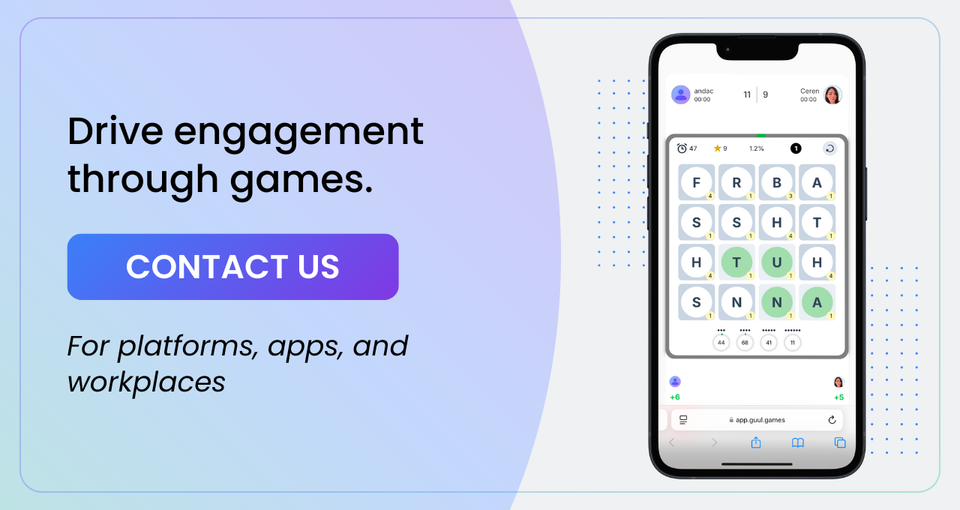
At Brandweek Istanbul, a healthcare brand activated a custom branded gaming experience during their conference session. Attendees scanned a QR code on-site, entered a fully branded 120-second word game, and competed on a live leaderboard in real time. 35% of session attendees actively participated, demonstrating how low-friction access design translates directly into participation rates at live events.
Competitive continuity means ensuring that the competitive narrative of the event remains active for all participants throughout the full event window, not just during live sessions. A predictor game that runs from one week before the event to one week after it creates a competitive arc that includes participants from every time zone at every stage. A leaderboard that updates continuously gives every participant a visible position that motivates return engagement regardless of when they first joined.
Language and cultural fit is the dimension most often overlooked in global virtual event design. A trivia event with questions built around a single cultural reference set will generate unequal performance across geographic segments, which undermines the fairness of the competition and reduces participation motivation in underserved regions. Game formats with universal mechanics, word games, number puzzles, prediction games, and card games, perform more consistently across linguistic and cultural contexts than formats that depend heavily on culturally specific knowledge.
What to measure in global virtual events
Standard virtual event metrics, session attendance numbers and post-event survey scores, are insufficient for measuring the success of a global event. They capture the synchronous layer but miss the asynchronous engagement that often represents the majority of global participation.
A complete measurement framework for international virtual events includes four metrics that session attendance alone cannot capture.
Participation by region shows whether the event actually reached its intended global audience or whether it functioned as a regional event with a global label. If 80% of participation came from one geographic segment, the event was not global in practice regardless of how it was positioned.
Async-to-sync participation ratio measures how effectively the event activated audiences who could not attend live sessions. A healthy global event has meaningful participation in async formats from regions where live session attendance was low. If async participation mirrors the geographic distribution of sync participation, the async formats are not compensating for time zone constraints.
Return engagement rate measures how many participants engaged with the event on more than one day or in more than one format. A global event that drives a single interaction from each participant is a broadcast. A global event that drives multiple interactions across the event window is a community experience.
Zero-party data yield measures how much behavioral and preference data the event generated through voluntary participation mechanics. Predictor games, polls, and competitive formats generate consent-based behavioral signals that passive event formats cannot. For brands running global events with a data strategy, this metric represents the commercial output of the engagement investment.
How GUUL powers global virtual event engagement
GUUL's Gamespace platform and event formats are built for both synchronous peak moments and asynchronous sustained engagement, making them deployable for global audiences without a separate technical configuration for each region or time zone.
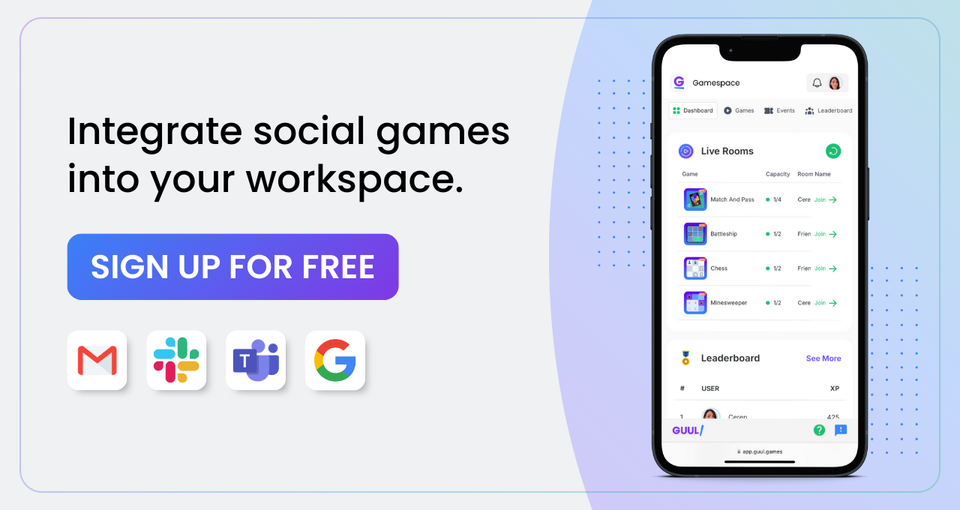
All event formats are browser-based and require no download or installation from participants. Access is via link or QR code, which means participants in any region join through a single entry point regardless of device or operating system. For organizations with existing SSO infrastructure, GUUL integrates with Microsoft Teams, Slack, and Google Workspace, meaning participants in those environments join through the tools they already use.
GUUL's event formats cover the full range of synchronous and asynchronous engagement needs described in this guide: Trivia, Tombola, Predictor, Daily Puzzle, Raffle, Wheel, Survey, and Poll. Each is configurable without technical involvement: an administrator sets the parameters, defines the prize structure, and launches. Events run on GET, GUUL's credit-based system where each format is priced by type and participant capacity, making costs predictable before a single participant registers.
For event agencies and brand teams running fully branded international activations, GUUL also builds custom branded gaming experiences scoped to the specific event: a dedicated environment with its own domain, visual identity, game selection, and competitive structure. The Brandweek Istanbul activation referenced above ran in exactly this format.
Key Takeaways
- Design for asynchronous participation first, then layer synchronous moments on top. Most global virtual event failures are synchronous-only designs with a global label.
- Match the format to the time zone distribution of your audience. If your audience spans more than four time zones, at least one async format should be the primary engagement mechanic, not a supplement to the live session.
- Measure participation by region, not just total numbers. A globally successful event looks different in the data from a regionally successful event with global distribution.
- Use game formats with universal mechanics for global audiences. Prediction games, word puzzles, and competitive leaderboards generate consistent participation across linguistic and cultural contexts in ways that culturally specific trivia formats do not.
- The zero-party data generated through global virtual event participation is increasingly valuable for brands operating under privacy regulations. Design the engagement mechanics to capture it intentionally, not as a byproduct.
Frequently Asked Questions
What are global virtual events?
Global virtual events are online events designed to generate genuine participation from audiences in multiple geographic regions, time zones, and cultural contexts. They differ from standard virtual events in that they are explicitly designed for distributed attendance, combining synchronous live moments with asynchronous engagement formats that activate participants regardless of when they are available. The defining measure of a global virtual event is participation distribution across regions, not just the absence of a geographic access restriction.
How do you engage a global audience in a virtual event?
Engaging a global audience in a virtual event requires combining formats. Synchronous formats like Live Trivia create shared competitive moments for participants who can attend at the same time. Asynchronous formats like Predictor games, Daily Puzzle challenges, and Custom Leaderboards sustain engagement for participants in different time zones before, during, and after live sessions. The most effective global virtual events use both, with the async layer doing the heavy lifting for geographic segments where live attendance is constrained by time zone.
What is the best format for international virtual events?
Predictor games and Custom Leaderboards are the most effective formats for international virtual events because they generate participation without requiring simultaneous attendance. Predictor games sustain engagement across weeks as real-world outcomes accumulate. Custom Leaderboards keep the competitive narrative active for all participants throughout the full event window. Live Trivia is the best format for creating a shared peak moment, but it works best as a complement to async formats rather than the primary engagement mechanic for a genuinely global audience.
How do you measure virtual event engagement across regions?
Measure participation rate by region, async-to-sync participation ratio, return engagement rate across the event window, and zero-party data yield from voluntary participation mechanics. Session attendance numbers alone are insufficient for global events because they capture only synchronous participation and miss the asynchronous engagement that often represents the majority of global participation. A complete picture requires tracking how different geographic segments engaged across the full event period, not just during live sessions.