Slack games for teams: top picks for 2026

Slack games for teams: top picks for 2026
Slack games turn a messaging tool into a space where teams actually want to spend time. Slack games for remote teams solve a specific problem: interactions limited to status updates and meeting links drain engagement fast. Adding games directly into Slack channels creates the kind of informal, competitive moments that build connection without requiring anyone to leave the platform. This guide covers the best formats across every category, from quick in-channel word games to multi-week predictor activations, including the ones that work just as well for Slack-based communities as they do for internal teams.
Key Highlights
- Puzzle and word games played directly in Slack channels are the highest-retention format for daily engagement, because they create a shared competitive moment without requiring coordination or scheduling.
- Quick games like Tic Tac Toe generate spontaneous participation between tasks, making them effective for teams that need low-friction ways to connect during the workday.
- Predictor games tied to real-world events sustain engagement across weeks, because participants stay invested in outcomes long after the initial activation.
- Poll formats deployed competitively with live visible results generate significantly higher response rates than standalone survey tools.
- Slack-based communities face the same engagement challenge as remote teams: keeping members active between structured touchpoints. The same game formats apply to both contexts.
Why Slack games work for remote teams and communities
Remote teams lose the informal interaction that happens naturally in a physical office. Slack games for remote teams replicate that dynamic without requiring a separate tool, a scheduled session, or any setup from participants. The game is already where the team is.
The same logic applies to Slack-based communities. Developer communities, brand ambassador groups, and user networks all face a version of the same problem: members join, participate in bursts, and gradually go quiet. A well-placed game mechanic in a shared channel creates a recurring reason to return, whether that is a daily word puzzle, a live predictor around a shared interest, or a quick poll that sparks a thread. Slack community engagement is not a separate discipline from team engagement. It is the same mechanic applied to a different audience.
What makes Slack games particularly effective is the zero-friction access. There is no app to download, no account to create, and no separate tab to open. Participation happens in the channel the team or community already uses every day.
The best Slack games by format
Not every format fits every team. The table below maps each category to its participation style and the engagement outcome it delivers best, so you can match the right game to your team's needs before going deeper into each one.
| Format | Best for | Participation style | Why it works |
|---|---|---|---|
| Daily puzzles | Daily engagement | Async | Creates repeat return habits |
| Quick games | Casual interaction | Real-time | Low-friction participation |
| Predictors | Long-term engagement | Async | Sustains participation for weeks |
| Polls | Community interaction | Live/async | Drives visible discussion |
Puzzle and word games are the strongest format for daily habit formation in Slack. A short, repeatable challenge that resets every day gives team members a reason to open the channel even when there is nothing work-related to respond to.
Find the Word is a Wordle-style game played directly inside a Slack channel. Players guess a five-letter word in a limited number of attempts, and results post in the channel for everyone to see. The shared leaderboard creates a daily competitive moment without requiring any coordination. It is one of the most played formats in GUUL's Slack integration because the mechanic is immediately familiar and the session length fits naturally between tasks.
Nerdle brings the same daily format to number-based challenges. Instead of guessing a word, players solve a mathematical equation in a limited number of tries. It appeals to a different audience segment within the same team and keeps the daily puzzle format from becoming repetitive.
Both formats work for communities as well as internal teams. A developer community running a daily Nerdle in their Slack workspace creates the same habit loop as an internal engineering team.
- Best for: Daily engagement, habit formation, mixed-skill teams
- Participation style: Async, individual with shared results
- Why it works: Resets daily, results visible to the whole channel, zero coordination required
Quick games in Slack
Quick games are the spontaneous format. They do not require a scheduled activation or a prize structure. A team member starts a game in the channel, another joins, and a three-minute match happens between meetings.
Tic Tac Toe is the most accessible quick game format in Slack. Two players, no rules explanation needed, resolution in under two minutes. It generates the kind of casual interaction that makes a remote team feel less remote.
Other quick game formats extend this into slightly longer sessions while keeping the same spontaneous entry logic. Rock Paper Scissors and fast word games all fit the quick game category. The common thread is low commitment: a player can join, finish, and return to work without losing context.
Quick games are particularly effective for communities where members have varying levels of activity. A low-barrier game that anyone can join in thirty seconds brings lurkers into the channel in a way that longer formats do not.
- Best for: Spontaneous connection, low-activity channels, workday breaks
- Participation style: Synchronous, two-player or small group
- Why it works: No scheduling, no setup, immediate competitive resolution
Predictors in Slack
Predictor games are the format for sustained, multi-week engagement in Slack. Where quick games happen spontaneously, predictors are built around a real-world event calendar: a sports tournament, a product launch, an awards ceremony, or any moment with a predictable outcome and an engaged audience.
Predictor games work by letting participants submit predictions before the event, accumulating points based on accuracy as results come in. The leaderboard evolves throughout the event window rather than resolving in a single session. A Champions League predictor running in a team Slack channel across a tournament window keeps engagement active for weeks without requiring a single scheduled activation.
Predictors are especially powerful for communities built around a shared interest. A gaming community predicting esports tournament outcomes, a finance community predicting market movements, or a sports community running a season-long predictor all use the same mechanic. The real-world event does the engagement work. The game captures it.
- Best for: Multi-week engagement, community events, moments your team or community already cares about
- Participation style: Async, leaderboard-based
- Why it works: Anticipation drives pre-event participation, real-world outcomes sustain engagement long after the initial activation
Polls in Slack
Polls are consistently underestimated as an engagement format because they are typically used as feedback tools rather than competitive mechanics. When poll results are visible to the whole channel in real time, the dynamic changes: members participate to see how their view compares to everyone else's, not just to submit a response.
A well-deployed Slack poll generates discussion threads, friendly disagreement, and return visits to check how results have shifted. The topics do not have to be work-related. A poll about the best work-from-home snack, the most overrated productivity tool, or the outcome of a shared cultural moment generates more participation than a project status poll, and it builds the same kind of channel energy as a quick game.
For communities, polls are a direct line to member opinion that feels more interactive than a form or a survey link. Posting results live in the channel rather than sending a follow-up summary keeps the conversation in the space where the community already gathers.
- Best for: Town halls, team check-ins, community opinion gathering, topical moments
- Participation style: Live, async-compatible
- Why it works: Visible live results turn a passive feedback tool into an active participation moment
How GUUL brings these games to Slack
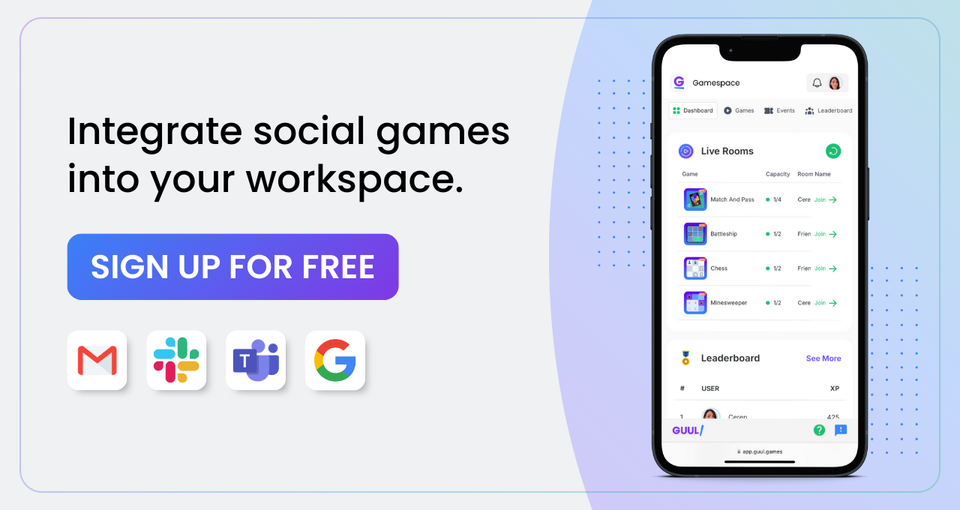
GUUL for Slack brings all of the formats above into a single integration. Find the Word, Nerdle, quick games, Predictor formats, and Polls are all available directly inside Slack without leaving the platform. Players sign in with their Slack credentials, join a Gamespace, and start playing in the channels they already use.
The admin layer gives team managers and community moderators full control without technical involvement. Games can be activated or deactivated by channel, event schedules can be set in advance, and leaderboards track performance across the full team or community. For communities and teams that want a fully branded environment, GUUL's Gamespace can be configured with custom visuals and scoring logic.
GUUL is available on the Slack App Marketplace. Installation takes minutes, and the first games can be running in a channel the same day.
What to consider when choosing a Slack game
Four variables determine which format is right for your team or community: activity level, session availability, group size, and the engagement outcome you want to achieve.
Activity level is the first filter. Low-activity channels benefit most from async formats: daily puzzles and predictors give members a reason to check in without requiring everyone to be present at the same time. High-activity channels can support quick games because the audience is already there.
Session availability matters for synchronous formats. Quick games require two people to be available simultaneously. If your team spans multiple time zones, async formats are the more reliable choice.
Group size affects leaderboard dynamics. Puzzle games and predictors work at any size because the competition is against the leaderboard, not against a specific opponent. Quick games work best in smaller groups or can be run as a bracket across a larger team. Polls scale to any size without adjustment.
The outcome you want shapes everything else. If the goal is daily return visits, puzzle games and daily challenges create the strongest habit loop. If the goal is sustained engagement over weeks, a Predictor around a shared event delivers it. If the goal is member opinion and community feedback, Polls generate the most structured insight while keeping the interaction inside the channel.
Key Takeaways
- Start with a daily puzzle format if your Slack channel has low engagement between work topics. Find the Word and Nerdle require no scheduling and reset automatically, making them the lowest-effort way to build a daily interaction habit.
- Use Predictor games when there is a real-world event your team or community already cares about. The external event does the engagement work, and the game captures and sustains it.
- Deploy Polls competitively with live visible results rather than as silent feedback forms. The difference in participation rate is significant.
- For communities, the same formats that work for remote teams apply directly. The mechanic does not change; only the audience does.
- If your team spans multiple time zones, prioritize async formats: daily puzzles, predictors, and leaderboard-based games over synchronous events that require a shared time window.
Frequently Asked Questions
What are the best games to play in Slack?
The best games in Slack depend on what your team needs. For daily engagement, word and puzzle games like Find the Word or Nerdle work best because they reset every day and post results in the channel automatically. For spontaneous connection, quick games like Tic Tac Toe require no setup and resolve in minutes. For sustained multi-week engagement, Predictor games tied to real-world events keep participation active without requiring scheduled sessions.
How do you add games to Slack?
Games can be added to Slack through app integrations available on the Slack App Marketplace. GUUL for Slack installs directly from the Marketplace, connects to your workspace with a Slack sign-in, and makes games available in any channel you choose. No separate accounts, no additional tools required.
Do Slack games work for remote teams across different time zones?
Yes, but the format matters. Async games including daily puzzles, predictors, and leaderboard challenges work across any time zone because participation is not tied to a shared window. Synchronous formats like quick games require two people to be available at the same time. For globally distributed teams, async formats are the more reliable default.
Can Slack games be used for community engagement, not just internal teams?
Slack-based communities use the same game formats as internal teams with equal effectiveness. Developer communities, brand ambassador groups, and interest-based communities all benefit from daily puzzle formats, predictor games tied to relevant real-world events, and polls that drive visible discussion. The mechanic is the same; the topics and reward structures are adapted to the community's interests.
What is the easiest Slack game to start with?
Find the Word is the easiest starting point. It runs directly in a Slack channel, requires no configuration beyond installation, resets daily, and posts results automatically. Most team members are already familiar with the Wordle format, which eliminates any learning curve. A channel can have its first daily game running within minutes of installing GUUL for Slack.